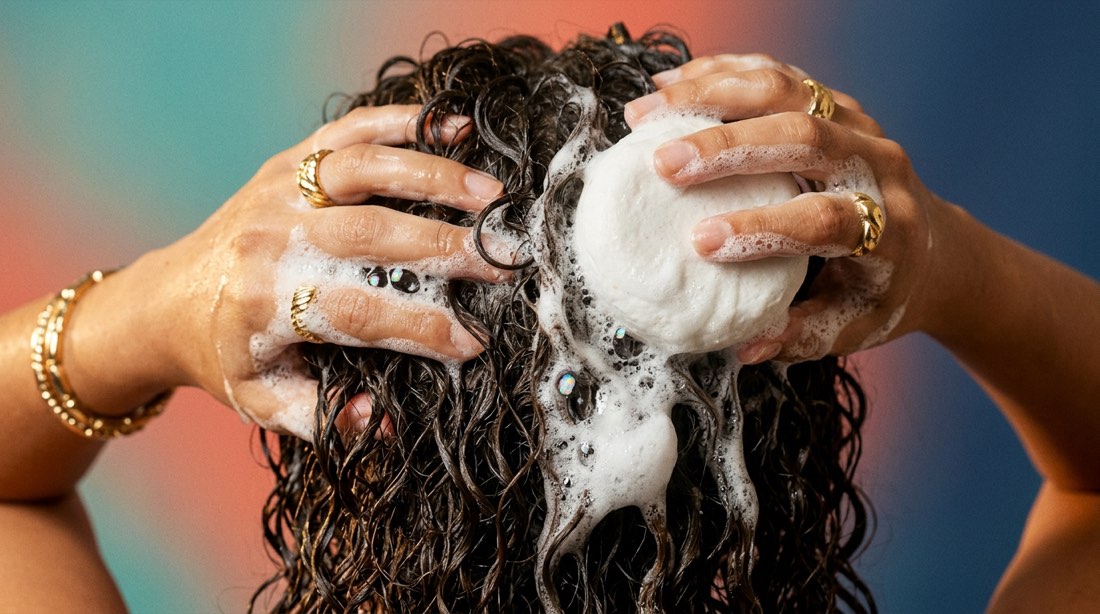
It's the fair question. You've used liquid shampoo your whole life, it works fine, and now you're being asked to rub a bar on your head and trust that it cleans just as well. So: does it? Yes. A well-made shampoo bar cleans as well as liquid, lathers as well as liquid, and leaves hair as clean as liquid. The format was never the problem. A bar is just shampoo with the water removed and the plastic left off.
The catch lives in two words: well-made. Not every bar is, and that's where the doubt comes from. For years, "shampoo bar" mostly meant a bar of soap. Soap cleans, but it's alkaline, up around pH 9 to 10. Your hair is acidic, around 4.5 to 5.5. Wash acidic hair with an alkaline bar and the cuticle swells open. You get the squeaky-then-straw feeling, the waxy film, the tangles. People tried those bars, hated them, and decided bars don't work.
The bars worth using aren't soap. They're built from the same gentle, sulfate-free surfactants as a good liquid shampoo, pressed into solid form and balanced to hair's natural pH. Same chemistry that works in a bottle, minus the water you'd be paying to ship.
The pH test
If a bar lists "saponified oils" or reads like a soap recipe, it's soap. If it's built around surfactants and tells you it's pH-balanced, it's shampoo. The first will fight your hair. The second won't. It's the single biggest predictor of whether a bar will work for you.
A bar that works does exactly what the bottle did. Wet your hair, wet the bar, work up a lather. A good one builds full lather in about ten seconds. It cleans the scalp without stripping it, rinses clean, and leaves nothing behind. Ours, the Coconut Oat Shampoo Bar, is pH-balanced and built for daily use, with colloidal oatmeal to keep the scalp calm. One bar does the work of a bottle, often more.
What you do differently is small, and it comes down to two things. The first is technique — building lather from a bar is a slightly different motion than squeezing a bottle, and it takes a wash or two to get the feel. We cover it in how to use a shampoo bar without the buildup. The second is a short adjustment period, if you're coming off stripping liquid shampoo. Not always, but sometimes. That's the scalp recalibrating, not the bar failing, and the transition period has the full picture.
Honesty cuts both ways, so here's who bars don't suit. If you need a specific medicated formula your dermatologist prescribed, use that. If you want the exact liquid experience with zero change to your routine, a bar will ask for a little flexibility. And if you try a cheap soap bar, decide bars don't work, and never touch a real one, that's a fair outcome — we'd just rather you judge the category by something built properly. For most people, with the right bar, the answer holds: they work.
What “working” should look like
“Works” shouldn't be a feeling. It should be a checklist. A bar that works builds a full lather in about ten seconds. It rinses out completely, no film, no wax, no squeak that turns to straw by evening. Your scalp feels clean but not tight. Your hair moves. That's the entire test, and you can run it on the first wash.
If a bar fails that test, one of two things is happening. Either it's a soap bar wearing a shampoo costume, or your water is working against you. Hard water makes any bar work harder; if the lather dies fast and the rinse feels filmy in a house where liquid shampoo behaved, that's the water talking, not the format. A pH-balanced surfactant bar in reasonable water passes the checklist without asking for faith.
By hair type
Most doubt about bars is really doubt about fit. Fair. Here's the honest map.
Fine and oily hair tend to do well on a bar. The wash is thorough, nothing heavy gets left behind, and there's no residue to flatten what little volume fine hair guards. Thick, wavy, curly, coily: the shampoo side cleans without a fight; it's conditioning that carries the real weight for you, and we wrote conditioner bars for thick and curly hair on exactly that. Color-treated hair is safe here. Sulfate-free means the wash doesn't strip your color. Sensitive scalp is who the colloidal oatmeal in ours is for. And if fragrance is the thing you're avoiding, ours never had any.
How long one actually lasts
A bar runs 50 to 75 washes. Call it two to three months of regular washing, usually outlasting the bottle it replaced. Where you land in that range is mostly storage: a dish with drainage, a bar that dries between showers, and you'll see the far end of it. Leave it in a puddle and you won't. The full storage math is written up on the conditioner side, and every rule holds over here.
Travel is where bars stop being equal and start winning
A bar is not a liquid. TSA agrees. No 3.4-ounce limit, no quart bag, nothing bursting in your luggage at altitude. One bar covers a month on the road in the space of a deck of cards. The full ruling is on file if you want it.
The label test, one more time
Because it decides everything: read the first line of the ingredient list. Saponified oils means soap, and soap fights your hair. Named surfactants and a pH claim means shampoo in solid form. Two seconds, and you know which category you're holding. The full decoder is worth the read before you buy anyone's bar, including ours.
So the verdict is a plain one. A good shampoo bar performs like good liquid shampoo. It asks for a little technique and, sometimes, a couple of weeks of adjustment. In exchange you drop the plastic, the water weight, and the bottle. Still deciding? Read the bar versus liquid comparison. Good things take time to prove themselves. Let it cure.